
The
Exhibition
o 's
The Framed
Displays not in chronological order;
Underlined links on bottom Left gives more info
butterfly by Zacxophone via GIPHY


00 / Untitled

00 / Peonies


00 / bubula denuo excogitata


11/ Somnambulismus


00 / Maltese Crocus

All graphics are taken by me unless otherwise stated.
01 / Untitled
In terms of composition, I remained faithful to the initial sketch. The slight distortions in proportion bestows the piece a measure of individual character. Underhandedly, it brings about nicely the mediterranean colors.
The naked table cloth attributes a heaviness to the top half of the drawing. I suppose this is what having one's head up in the cloud look like, slightly imbalanced.
Ever since Theo left, my art lost it's recklessness, lost that completeness.
Informal explanation before citing C&L or other standard Text.


02 / Untitled
Oranges are my mother's favorite too. The Maltese house I now live in is called Klementina as well. A citrus tree at the garden's end bears harvest each fall.
In this particular piece, I had relied heavily on white acrylic to synthesize a resemblance to "gouache". This experience afforded me a renewed appreciation for watercolor.

"Klementina"
03 / Sunflowers for angie
Completed over the course of two days, just before the start of my eleventh-grade year.
Looking at it now, I can still feel the vigour of the cornflower, a heap of unfurling indigo. My brushes were dipped in confidence, each leaf emerging from a single, unhesitant stroke. The cluster of sunflowers came last, their forms left in negative space. Their pallor reflected my willingness to embrace the undefined. Slightly restless, yet fundamentally receptive to change, I had enclosed these contradictions within a clear globe of glass.
After all, in eleventh grade, I wore my heart on my sleeve.
Maybe I will never paint with the same spontaneity as I did here, compare this to 01/Untitled and yes you will see how I have changed.


Theo is my brother. You have never seen my brother? True, I have no brother in the physical sense.
Still, he had his share of this planet. Vermilion and moss green, in particular, held his earthly affection. Beyond their stereotypical association with Christmas, where the combination evokes cheap plastic ornaments, the colours assume a different significance in the East, particularly in Japan. There, vermilion has long adorned sacred architecture, while moss creeps over stone and once-pallid walls sink into age. Nothing quite rivals the brilliance of red, save for the crisp green of summer maples.
Yes, that was the strongest impression left by Japan. And trust me, some colours scorch the cornea (in a good way).
You seem absorbed in the flowers. You must have noticed the vase of red poppies on the table. Theo, as it happens, had a particular predilection for them. How their silky petals unfurl to reveal a crown of fringes! Sometimes bruised purple and black, their centres cradle a symmetrical stigma, pretty as some foreign star. Yet, for all the weight of their blooms, their slender necks bow earthward, only to rise at the faintest gust.
Does In Flanders Fields come to mind? Ah, Theo would sometimes stroll between its verses, his face perpetually downcast. Was he mourning the fallen or admiring the flowers? Not even I know.
Perhaps the distinction mattered little to him; he often insisted that, were death to have a symbol, none could rival the crimson poppy. In this conviction, I find echoes of him time and time again. Few flowers wear their vulnerability so plainly, lay bare their corroded hearts with such unvarnished bluntness, or grow fine hairs and feathery leaves to feel the world, only to be shunned for their poison. Theo had been sensitive like that, and his heart bled red all the same.
If you know him as I do, surely you will come to respect him, pity him, and love him as I do.
What is there to pity? It is true that flowers alone cannot elicit a complete portrait of Theo. Yet I cannot complete it without distastefully dragging my own past into the narrative. Some stones are better left unturned, after all. Still, this naturally leads one to question the skeletons: the trio in the painting is hiding something. Oh, was I supposed to know? Sadly, this was Theo's swan song, and, like you, I remain an audience, with no right to elevate my interpretation into a verdict.
For now, remembering him through these flowers is more than sufficient. After all, do these blooms not evoke a certain melancholy?


Inspired by the narrative approach of The Reluctant Fundamentalist. It seems I cannot speak of this painting without inadvertently writing a novella. Like a cyst, it demands either complete excision or to remain undisturbed.
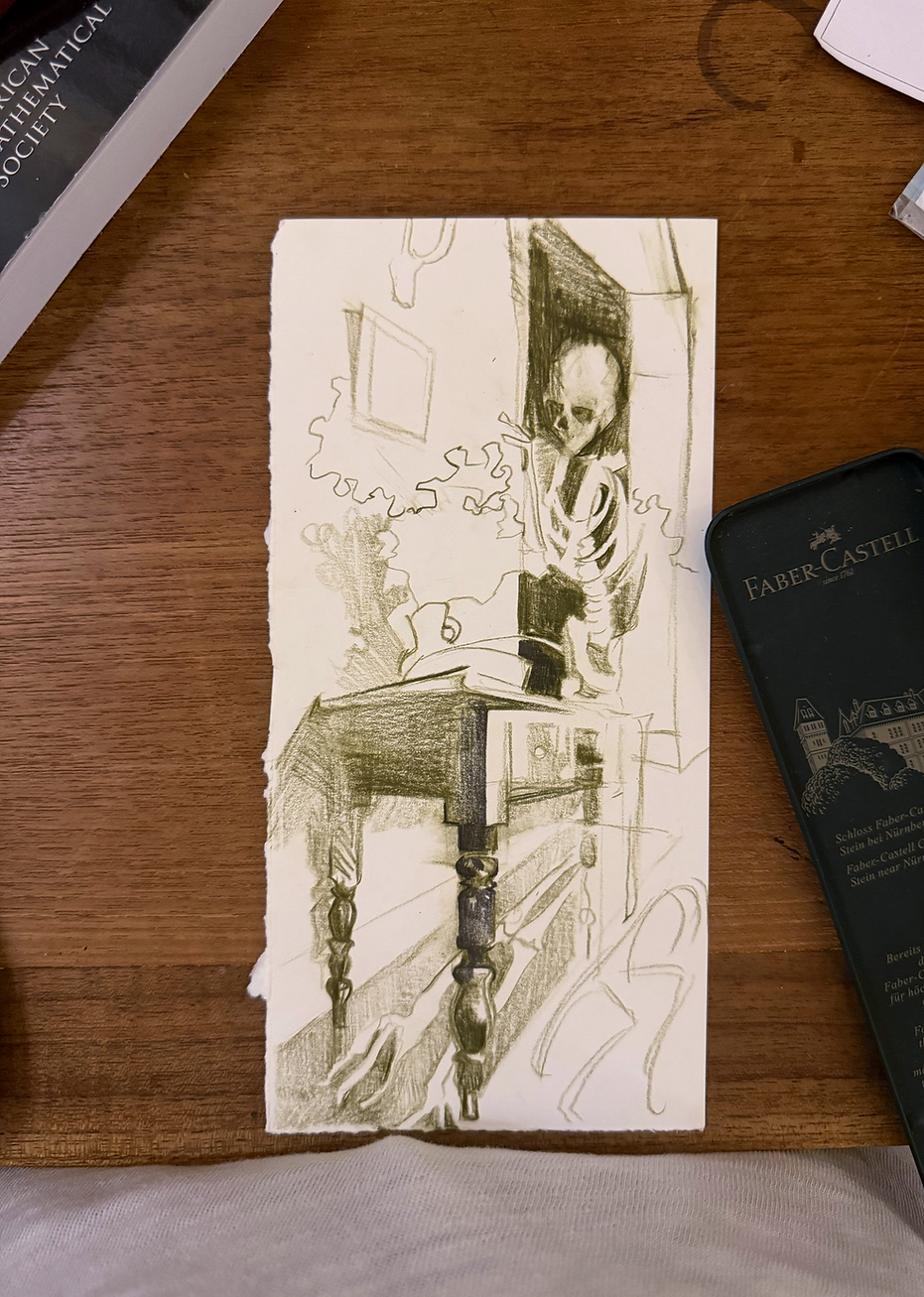
04 / Theo

05 / Carne Viridis
Why does gore evoke such visceral disgust? During the summer of 2025, I documented my responses to repeated exposure to graphic imagery, with teratomas being a particular subject of interest.
What fascinated me was not the grisly butchery itself, but the corporeal manifestations of my own revulsion: the tension in my abdomen, the quickening of my heartbeat. Yet, through repeated exposure, medical professionals and forensic investigators often become acclimatised to such imagery, their initial visceral responses gradually attenuated.
This investigation into the flesh naturally led me to consider plant life. When a stem with intact vascular tissues is bent, its tensile structure yields under pressure, allowing fluid to seep out without necessarily breaking. Though deformed, the stem retains a measure of structural integrity. The parallel between a damaged stem and a fractured arm offers a striking juxtaposition, prompting me to question why we recoil from the violation of one form of life, while the other is met with relative indifference.

This pot sits on the balcony outside the master-bedroom

06 / A priori
Smoke billowed from his pipe, his slender silhouette etched against the twilight of my study. The Albany desk lay buried beneath folios of drawings; fair to say, I had left myself scarcely any room to study.
His name was Then, though he bore a striking resemblance to Francis Kupka. He told me to open a book at random, and that the very first letter on the page would spell his name. Then, it seemed, the Grim Reaper was not a singular entity after all. A few days prior, Then had taken me by the hand—or, more plausibly, it had been Theo’s—and claimed that we had evaded death.
Was that how I came to see spirits?
That night, we danced; I drew. Angie had been there too, sitting languidly upon the couch after considerable skips of delight. Her long skirt flared elegantly about her. She possessed that smile, you know, the kind that singularly disarmed Theo.
Enough about the concurrent festivities that accompanied the drawing's creation. Retracing my narrative, I find that its inception lay in the ajar bedroom door, through which strands of golden light had escaped. They scattered across the hallway, geometricising the once-coherent mass we knew as night. Tip toeing back to my room I took my phone to reconvene with the sight before me.
Perhaps it was the familiarity of the hallway that rendered this exhibition of light so spectacular: a fluke of the extraordinary amidst the mundane. Coincidentally, I had opened Kant's Critique of Pure Reason just hours later. Does his discourse not disarm reality with an equal beauty? This must have been truth—a truth that bisected the abyss of immediate reality, transcending the material world, conjured from some unknown origin.
That was a priori.
Theo drew for many. As much as he relished the process of creation and the satisfaction of seeing a creative impulse realized, there was a collateral joy in imparting his works to others. This particular piece, however, was drawn for me. The elephant has been with me for twelve years now, the hippo for seven.
Had it been left to me, more of our art would have remained in our keeping, secured behind a binder rather than dispersed across the world—or sold for as little as ten euros at a school Christmas fair.
Could just anyone comprehend his prodigality? How he returned crying from a art competiiton where he submitted a Priori
Theo saw himself as the river’s source, through him flown an inexhaustible current of creativity. What then, were a handful of clear dewdrops to him? We wept so much too. He would drench us all, if only you let him. Let him know how much you value his art; let him know how much you value him.


07 / My Stuff Animals


08 / Sua Sponte
In Latin, this translates to “of one’s own accord”.
Among the older drawings showcased in this exhibition, no other piece better captures the aspirations of a first flight.
I drew this at the beginning of Grade 10, in early 2024, when I believe I was circumscribed by only one boundary: the limits of my own consciousness.
I had been the bee perched upon the edge of its ceramic leaf. Grades simply failed to register in my mind; instead, I pursued my own passions and understanding through independent reading, venturing into that tingling existential chasm that cleaves the familiar ground of reality.
It was this inward autonomy that imbued my color pencil drawings, produced between the summer of 2023 and the winter of 2024, a particular luminosity.

This bordallo pinheiro oak leaf remains in my bedroom. Ironically.
09 / Untitled
A few streets down from my house, the school bus passes each morning beneath a statue of a woman bearing a cross. Perched atop a community centre, her marble-white skin bears the brunt of weather and erosion. From her elevated vantage, she overlooks a small plaza, where herds of plastic chairs, their bloated bellies brimming with liquor, congregate beneath her gaze.
I had, quite politely, drawn her blind. I cleansed her of blemishes and discolouration and replaced the people with flowers.
There is something anachronistic about her. On a second thought was there ever an era on earth for her? Surely no angels wants to roam this earth, the only ones that remain are set in stone.
10 / Swallowtails
Butterflies have long been a recurring subject in our drawings. From Roman antiquity to Japanese folklore, these creatures have been imbued with significance beyond their idle elegance: harbingers of the soul they call it. Air born messengers with fragile wings.
As readers, we, me and Theo inevitably come to cherish certain authors, and for a long time, at the podium was Vladimir Nabokov. Whether our fascination with these insects originated in an imitation of Nabokov, or our pre-existing affinity for them rendered the lepidopterist-author all the more venerable in our eyes, I can no longer recall.
From reading Nabokov's short stories, one can safely deduce he had a keen eye for color. "Fulvous", "glaucous" were two I learnt from him. He wielded scientific precision, yet follows a poet's instinct for lyricism. This allowed him to uncover the most remarkable of metaphors, all whilst enlisting those elusive descriptors the great majority of humans have to decay. Sadly, such lexical style diminished significantly in Lolita, inarguably his magnum opus though only secondary to his short stories in my opinion. He would calls those the "shivers" and inevitably lost them when it comes to producing a novel.
Let Theo be the poet and I will be the scientist. Nabokov too is an artist.

Sadly I don't see these guys often and I do not endorse in making specimen out of them.

Another Butterfly by Zacxophone via GIPHY
11 / Somnambulismus
An unprompted school art project granted me the autonomy of choice. Around the same time, I had been reading Sigmund Freud’s The Interpretation of Dreams. When we are young, it is so much easier to be wholly transfixed by an idea. Notions arrive with such brilliance, so incandescent, that they occupy the mind in all their wonder.
Now, at seventeen, on the cusp of eighteen, I find that my mind has erected partitions. It arranges itself into neat little cubicles, as I began to place school in one, interpersonal connections in another, and my passion—well, she has dislodged herself from her former quarters and retreated to the attic.
Someday, with a bouquet cradled in my arms, I shall present myself at her loft and beseech her to return. Promising her I can treat her as Theo once did.
Ugh, Theo would critique my art harshly, it lacks his self consuming ardor, I know. He once said "The world be damned, so long as I have my art supplies", blasting his indies rock, so raw, so unrefined.
Ahh, do you find me a doting younger sister? I am simply admiring what I am not, doesn't mean I don't appreciate my own competencies ( Read more Here )

Lucky me, I was able to find the google slide containing Theo's words regarding this piece, here are some extracts:
"Materialistic distortion is only the first step. The true enigma lies in that which can’t be perceived but is felt. I do not sleep in water. I do not see red. The viscous masquerade of a scarlet hue is simply the crystallization of angst. Angst for the paradox of this world."
"I had never presumed a drawing capable of evoking lightheadedness. The very vertigo illustrated no longer remains inert but haunts me."